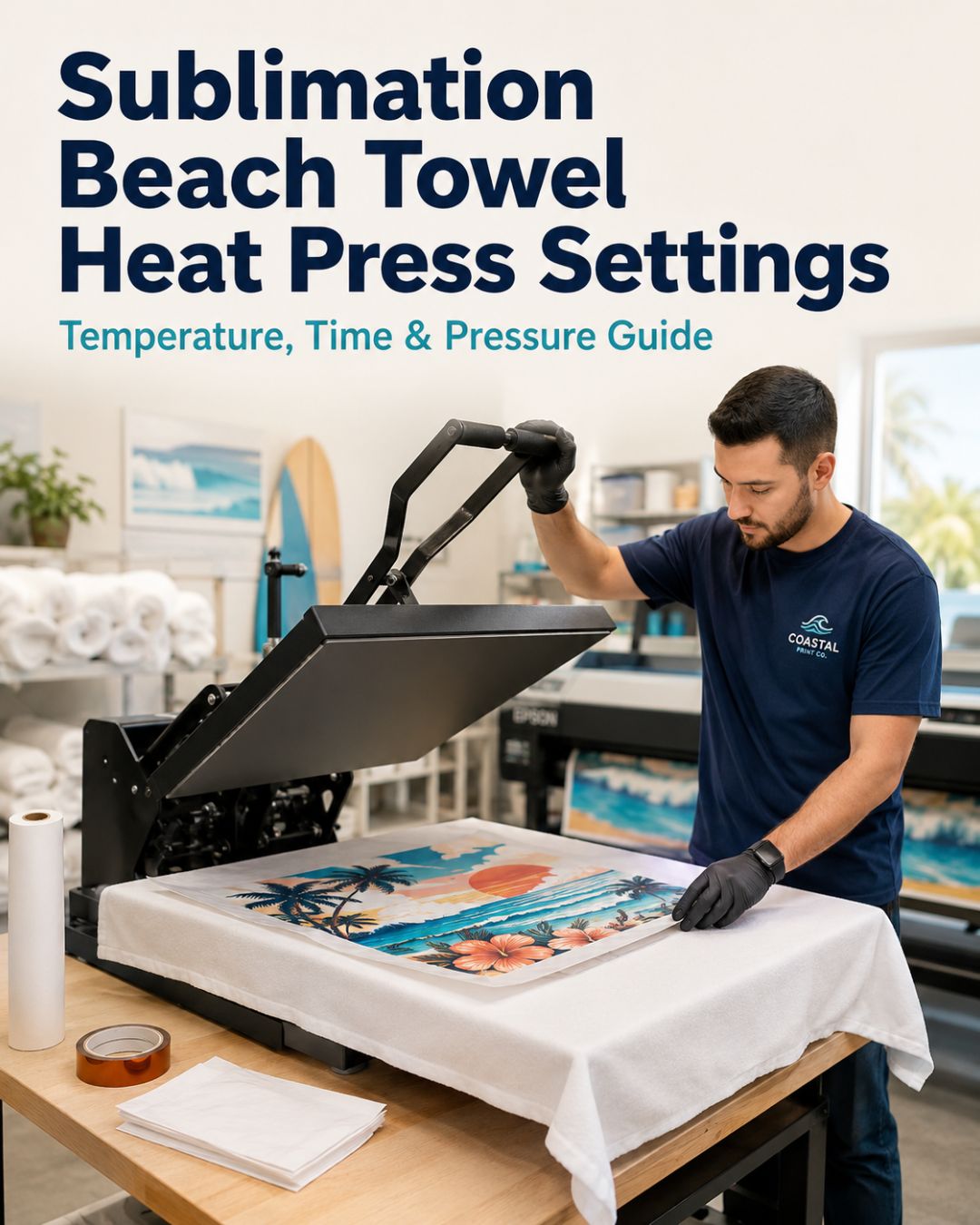
Print shops ask us the same question every week after ordering blank sublimation beach towels: what settings actually work? Guessing costs you a $10–$25 blank and 2 minutes of press time per failed attempt — cheap individually, expensive at 30-pack volume if you're dialing in settings on production stock. Here's what actually works on our 30”x60” polyester-front, cotton-terry-back towel, and why.
Recommended heat press settings
| Setting | Value |
|---|---|
| Temperature | 380°F (193°C) |
| Time | 60–75 seconds |
| Pressure | Medium–firm, even pressure across the full platen |
| Pre-press | 5–10 seconds, no paper, to remove moisture and flatten fibers |
These are starting-point settings, not universal law — every heat press runs slightly hot or cool depending on calibration, platen size, and ambient humidity. If you're running a new batch, press one test towel first and check color saturation before committing a full 30-pack run.
Why pre-pressing matters more on towels than most blanks
Terry cloth and microfiber velour hold more ambient moisture than flat polyester panels or apparel blanks. Skip the pre-press and that trapped moisture turns to steam under your platen mid-press — the most common cause of blotchy, uneven color on towel sublimation, and it's avoidable with a single 5–10 second dry pass before you lay down your transfer.
Common failure modes and what's actually causing them
Ghosting (faint double image): Almost always transfer paper shifting mid-press. Tape all four corners with heat-resistant tape before closing the press — terry cloth's texture makes paper slip more than it would on a flat blank.
Faded or washed-out color: Usually one of two things — the print side isn't hitting full temperature because of uneven pressure (terry pile compresses unevenly under light pressure), or the towel's polyester content is lower than expected. Sublimation ink bonds to polyester; anything under roughly 65% polyester on the print surface won't hold color through a wash cycle. Our blanks are 100% polyester on the print face specifically so this isn't a variable — if you're sourcing towels elsewhere, verify the print-side fiber content before running a design.
Scorching or fabric stiffness after pressing: Usually too much time, not too much heat. If color is saturating well before 60 seconds, don't keep adding time as a habit — over-pressing terry cloth flattens the pile and leaves it stiff. Pull time down in 5-second increments until you find the shortest press that still gives full color.
Blank, 30-pack, or custom-printed — which one do you actually need?
If you're testing a new design or dialing in settings for the first time, start with a single blank towel rather than committing to a full case. Once your settings are confirmed, the 30-pack bulk case is the better per-unit price for production runs. If you'd rather skip pressing altogether, we also offer a custom-printed service where we handle the full-color print and ship the finished towels directly.
All blanks ship same-day from our Doral, Miami warehouse on orders placed before 2 PM EST.
Related reading: DTF vs sublimation: which setup makes sense for your shop, for more on why polyester content is non-negotiable for sublimation results.



Leave a comment
This site is protected by hCaptcha and the hCaptcha Privacy Policy and Terms of Service apply.