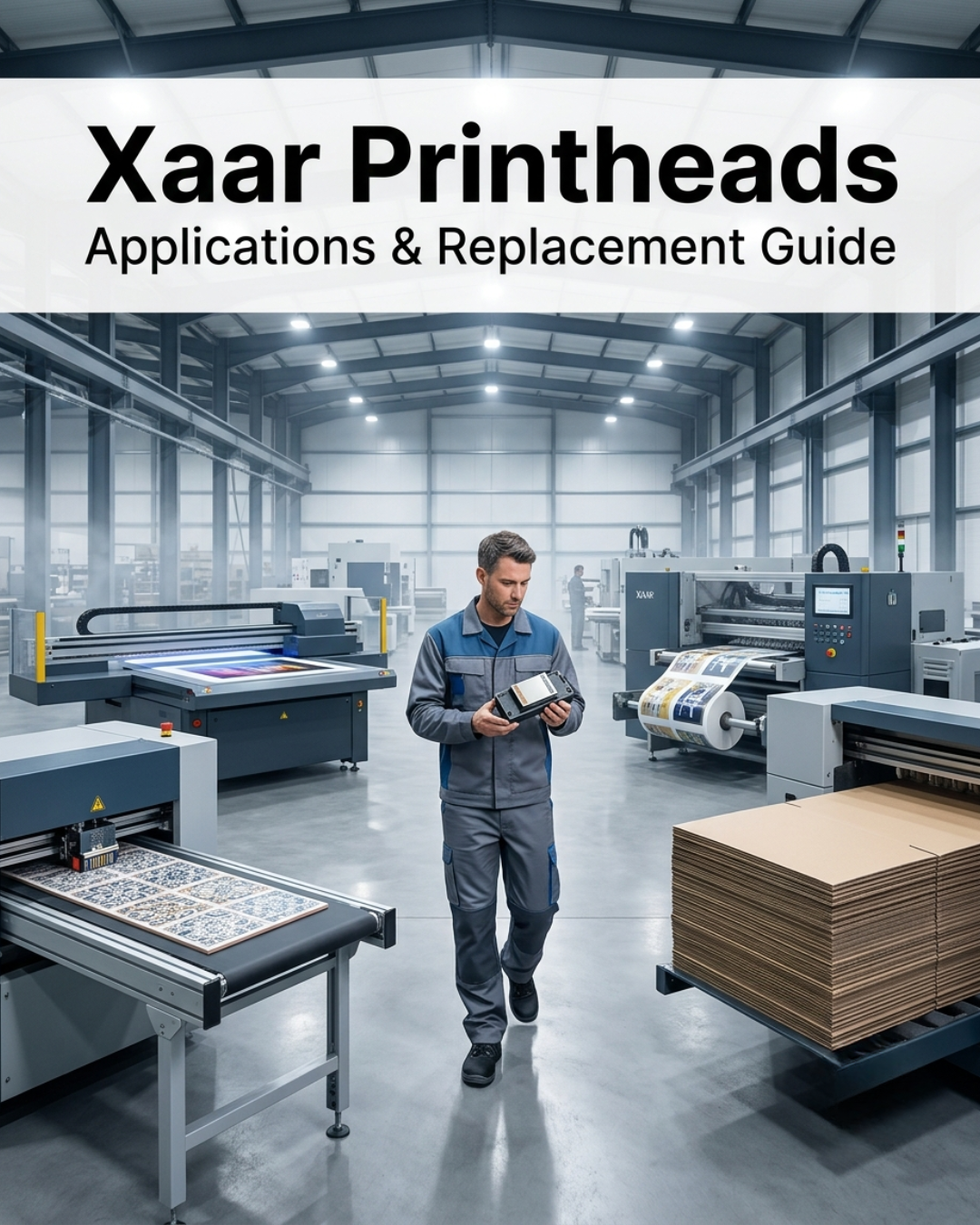
Xaar printheads sit outside the wide-format DTF/eco-solvent world most printer parts guides cover — they're the workhorse behind ceramic tile decoration, packaging, coding & marking, and direct-to-shape printing. Because these machines run in industrial production environments, unplanned printhead downtime is a bigger cost than the part itself. Here's how the Xaar lineup breaks down.
Xaar printhead models
| Model | Application |
|---|---|
| Xaar 128/80 | Coding, marking & general industrial inkjet |
| Xaar 1001 | High-speed ceramic tile & industrial printing |
| Xaar 1002 | High-viscosity inks, demanding industrial applications |
| Xaar 1003 (GS-6U, GS-12C, GS-12U) | Ceramic, packaging & direct-to-shape — current-generation workhorse |
| Xaar 1201 | Next-generation high-speed industrial production |
| Xaar 2001 | Ultra-high-speed, most demanding industrial applications |
The Xaar 1003 is the one most shops actually need
If your machine is a Xeikon Jetrion or a similar ceramic/label press, the Xaar 1003 in its GS-6U, GS-12C, or GS-12U variants is the current standard replacement. All three share the same High Laydown Technology core — the suffix refers to nozzle configuration and drive voltage, not a different generation, so the letters matter when ordering. The 1003 is built in the UK and is compatible with UV, solvent, and oil-based inks, with variable drop control up to 720 dpi.
1001/1002 vs. 1003: is it worth upgrading?
The 1001 and 1002 are still supported and widely used in machines still in production, but the 1003 is the direct successor with improved High Laydown consistency across print speeds — meaning less quality drop-off when you push a machine to its top speed. If you're replacing a failed 1001/1002 on an older machine, confirm with us first whether a 1003 is a compatible drop-in or whether you need to stay on the original generation — this varies by printer manufacturer.
Signs a Xaar head needs replacing (vs. an ink or maintenance issue)
Because Xaar heads run in industrial, near-continuous production, most "failed head" calls we get are actually ink system or maintenance-station issues. Our general printhead replacement signs guide and color shifting diagnosis guide cover the same diagnostic logic that applies to Xaar-based ceramic and label presses — rule out ink degradation and maintenance-station wear before ordering a new head.
Genuine vs. aftermarket on industrial heads
At this price point ($3,000–$5,000+ per head), the case for genuine OEM is stronger than almost anywhere else in wide-format — see our genuine vs. aftermarket printheads breakdown for why aftermarket risk scales with head cost, not just with failure rate.
FAQ
Is the Xaar 1003 backward-compatible with machines built for the 1001 or 1002? Not always — it depends on the printer manufacturer's carriage and driver board. Confirm before ordering.
What does the GS-6U vs. GS-12C vs. GS-12U suffix mean on the 1003? These refer to nozzle/channel configuration and drive electronics, not different print quality tiers — your printer manufacturer specifies which one your machine requires.
Can Xaar heads run UV and solvent ink interchangeably? The 1003 family supports UV, solvent, and oil-based inks, but switching ink types on an installed head requires a proper flush and manufacturer-approved procedure — check with us before switching ink chemistry on an existing head.


Leave a comment
This site is protected by hCaptcha and the hCaptcha Privacy Policy and Terms of Service apply.