
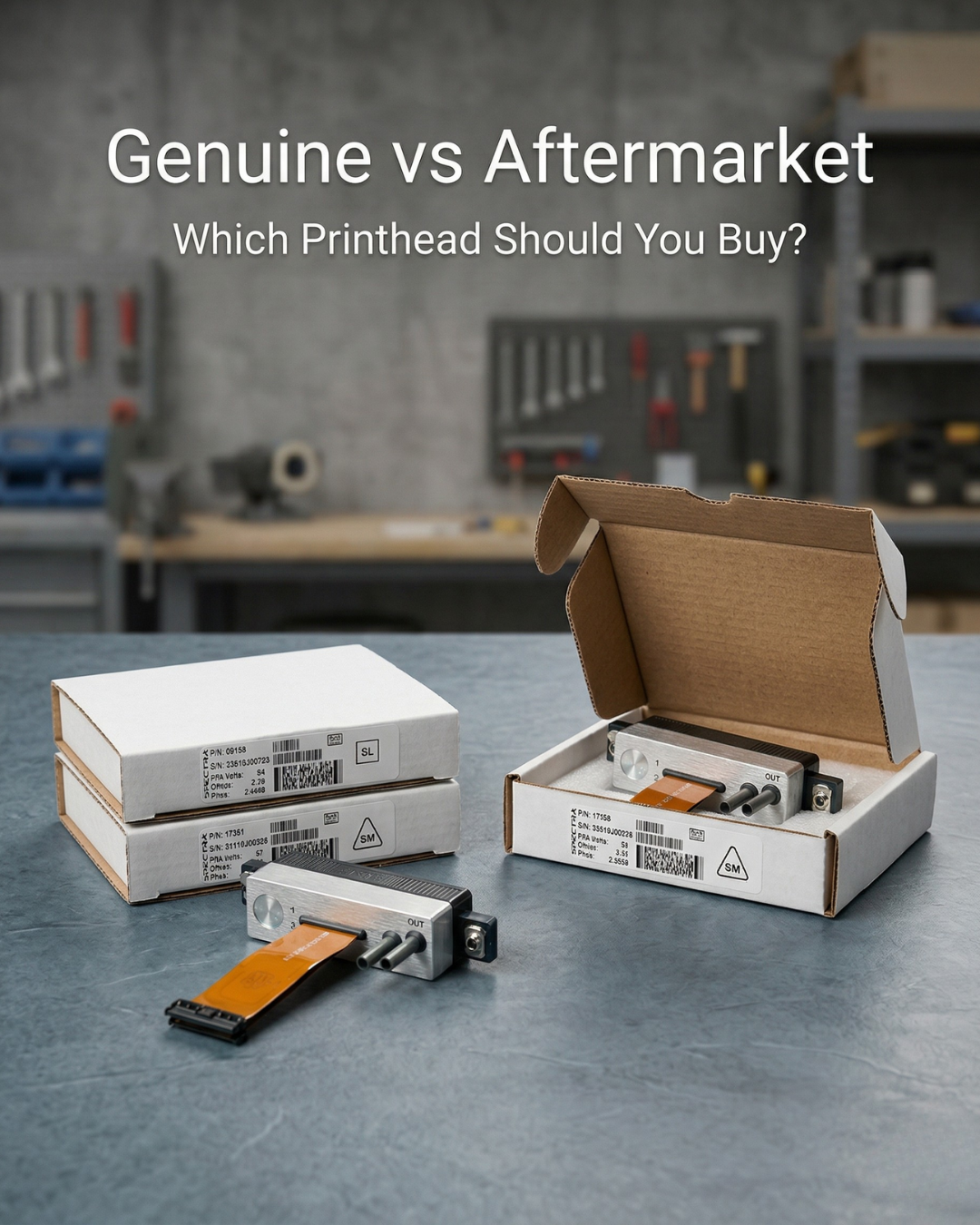
The price difference is real. An OEM Epson i3200-A1 runs around $900. Some aftermarket versions on eBay or AliExpress list for $200 to $350. That's a $500 to $700 gap on a single component, and it's tempting when you're already looking at a production stop.
Here's what that difference actually buys — and what you're gambling when you skip it.
Why the gap exists
Genuine printheads are manufactured to the parent brand's spec, tested before leaving the factory, and carry a warranty tied to traceable serial numbers. Epson PrecisionCore heads go through quality verification at 106 billion piezoelectric cycles before they're released. Each nozzle row is tested for consistent droplet formation across the entire viscosity range the head is rated for.
Aftermarket versions skip most of that. Some are refurbished OEM heads with the serial numbers removed. Some are new-manufacture clones built on cheaper piezo films. A few are legitimate third-party alternatives that perform adequately for lower-volume shops. Most are none of those things — they're rebadged units with no lineage documentation and no testable spec.
The issue isn't that all aftermarket heads are bad. The issue is that you can't tell which kind you have until it either works or fails, and by then you've already installed it.
What actually happens when a counterfeit head fails
The failure modes are predictable.
Nozzle inconsistency from day one. Clone heads often have nozzle rows with inconsistent droplet sizes — you get visible banding that doesn't respond to alignment adjustments because the problem is in the manufacturing, not the calibration.
Early clog cycles. Lower-quality internal coatings don't hold up against ink chemistry the way OEM materials do. A head that should run 12 to 18 months starts degrading at 4 to 6 months.
Electrical mismatch. The communication protocol between a printhead and its printer board is precise. Aftermarket heads that slightly deviate from the electrical spec can cause error codes, intermittent firing failures, or — in documented cases — damage to the printhead board itself. That turns a $200 gamble into a $200 head plus a printer board repair.
No warranty path. When an OEM head develops a manufacturing defect within the warranty period, you have a clear process: contact the supplier, provide the serial number, get a replacement or credit. When a counterfeit head fails, there's no manufacturer, no traceable unit, and no recourse.
The specific risk on DTF and UV setups
DTF printing puts more stress on printheads than most other applications. White ink has a high pigment load and settles faster than color channels. The internal channel coatings on a genuine i3200-A1 are rated for exactly this — the binder chemistry in DTF white ink is more aggressive than standard aqueous inks, and OEM heads account for that.
UV ink is even more demanding. UV-curable ink can flash-cure on the nozzle face under ambient light if the head doesn't have the right surface coating. Genuine UV-rated heads (like the Epson i3200-U1) have a different nozzle plate material than the water-based A1 variant. Using a clone that doesn't distinguish between these spec differences is how you get a head that fails in weeks on a UV flatbed.
How to spot a fake before you install it
This is harder than it should be, but there are checkpoints.
Packaging. Genuine Epson printheads come in a specific box format with holographic seals, a QR code that resolves to Epson's authentication system, and serial number documentation. The box weight, print quality, and label finish are consistent. Counterfeits often have off-register printing on the box, missing holograms, or QR codes that resolve to nothing.
Serial number verification. Epson's OEM verification process lets authorized resellers trace a serial number back to a specific production batch. If a supplier can't provide this, that's a flag.
The price. There's a floor below which a genuine head cannot be sold profitably. If you're seeing i3200 heads at $250, they're not genuine. The material cost and production process don't allow it at that price.
Supplier documentation. Authorized resellers have distributor agreements and can show them. Ask who their supply chain runs through. If the answer is vague or the supplier deflects, walk away.
Where legitimate third-party alternatives exist (and where they don't)
Some printhead manufacturers produce genuinely functional alternatives for older or discontinued heads. Certain DX5 and DX7 compatible heads have aftermarket options that work reliably for eco-solvent printing in lower-production environments. These are traceable products from real manufacturers, not resellers of unknown inventory.
But for current-generation heads — i3200, i1600, Ricoh Gen5, Konica Minolta KM512 — the aftermarket is almost entirely either refurbished OEM or counterfeit. The production engineering required to clone a modern piezo head to spec isn't available at the price points these products sell for.
The math on total cost
A genuine i3200-A1 at $900 with an 18-month lifespan in a medium-volume DTF shop works out to roughly $50 per month. Over that same period, an aftermarket head that fails at 5 months and needs replacement, potentially damaging the printhead board in the process, might cost you $350 for the head plus $200 to $400 for board diagnosis and repair — before you've bought the second head. The savings disappear fast.
The calculation that matters isn't purchase price. It's cost per operational month, factoring in downtime.
What Digiprint USA stocks and why it matters
Every printhead in Digiprint's catalog is genuine OEM — Epson, Roland, Mimaki, Konica Minolta, Ricoh, Xaar. Each unit carries the manufacturer's seal and full serial number documentation. Our supply chain runs through authorized distributor channels, not grey market sources, and we ship same day from Florida so a production stop doesn't mean a week of waiting.
We can verify the authenticity of any head we sell. If a supplier can't say the same, that's the answer you need.
The $500 you save on a counterfeit head is real money. So is the production day you lose when it fails, the board repair bill, and the second genuine head you have to buy anyway. Most shops that have been through one counterfeit failure don't go back. The ones that haven't usually only need to go through it once.


Leave a comment
This site is protected by hCaptcha and the hCaptcha Privacy Policy and Terms of Service apply.