
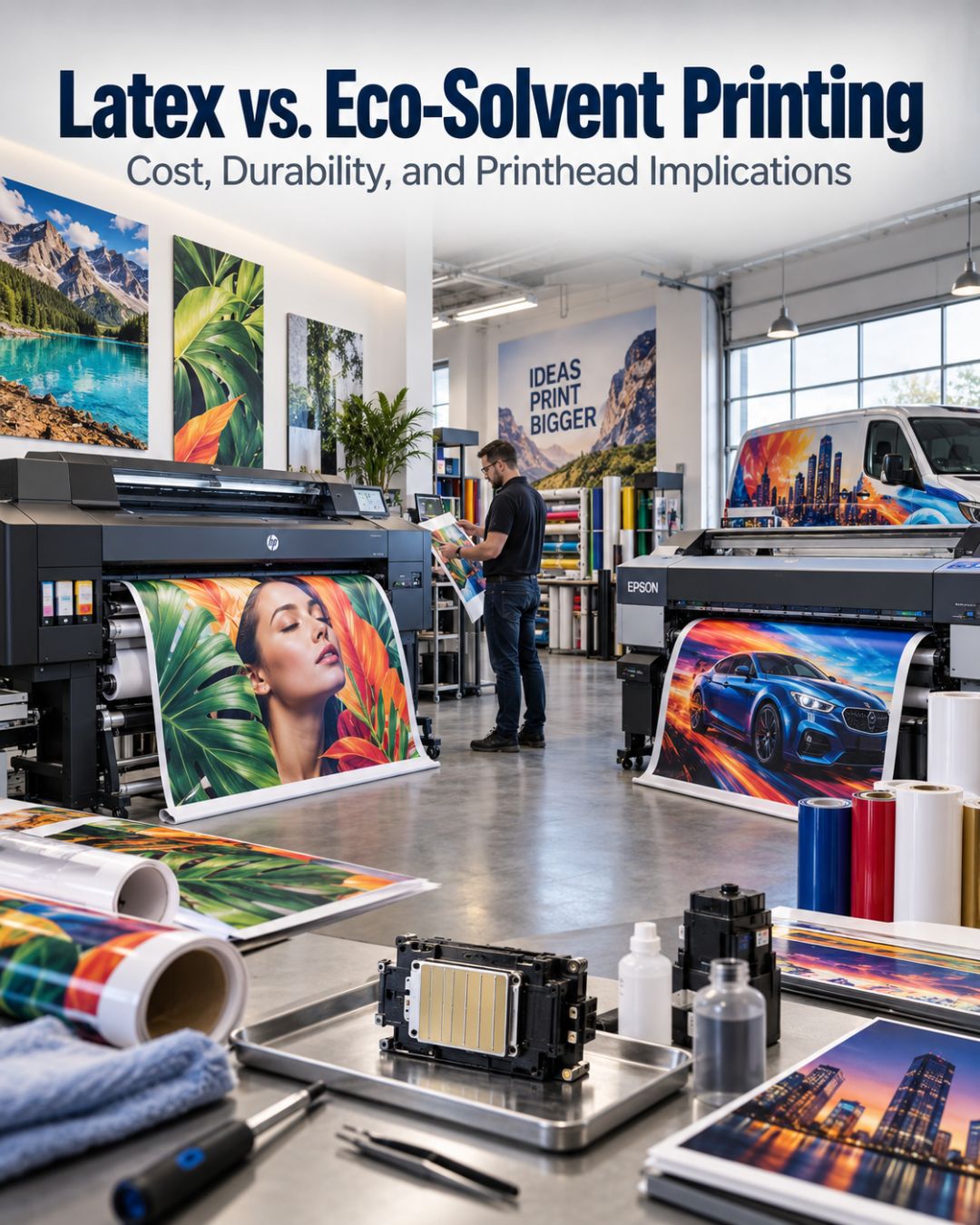
Latex and eco-solvent printers compete for the same sign, vehicle-wrap and banner work, and the output is close enough that most buyers decide on workflow and running cost. The printhead is the running-cost variable people underweight. The two technologies handle it in opposite ways.
How each technology puts ink on media
Eco-solvent uses a mild solvent carrier that bites slightly into vinyl for adhesion, then evaporates under the printer's heaters. It runs through piezo heads — Epson DX4, DX5, DX7, DX6 and now i3200-E1 — fitted in Roland, Mimaki and Mutoh machines. Latex (HP's term) is a water-based ink with a latex polymer that is fused to the media with high heat at the end of the print zone. HP Latex machines use thermal heads that the operator swaps like a cartridge.
The printhead difference in numbers
| Eco-solvent (piezo) | Latex (thermal) | |
|---|---|---|
| Head type | Epson DX5 / DX7 / DX6 / i3200-E1 | HP thermal, user-replaceable |
| Typical head price | $1,350–$1,498 per head | Low hundreds per head, several per printer |
| Expected service life | Years, with maintenance | Months; treated as a consumable |
| Replacement | Technician or experienced operator; alignment required | Operator, minutes |
| Failure mode | Clogs, cap/wiper neglect, strikes | Burn-out from heat; expected |
So the eco-solvent head is a rare, expensive event; the latex head is a frequent, cheap one. Over five years the totals converge more than the sticker prices suggest — which is why the decision shouldn't be made on head price alone.
Where eco-solvent wins on the head
- Longevity is in your control. A DX7 that's capped properly and wiped with fresh blades lasts years. The $28–$60 in cap and wiper parts every few months is what protects it.
- Cross-brand parts supply. The same DX5 sits in a Roland, a Mimaki and a Mutoh. That's why the RJ-900 head is an Epson part, and why supply is deep. Latex heads are HP-only.
- No thermal stress. Piezo firing doesn't heat the ink, so the head isn't consumed by the act of printing.
Where latex wins on the head
- No single catastrophic failure. A dead latex head is a $100-class annoyance, not a $1,400 emergency. That matters for shops without a technician.
- No solvent maintenance chemistry. Water-based flush, no solvent cleaning routine, less sensitivity to idle time.
- Prints are dry off the machine. Not a head issue, but it removes the outgassing wait that eco-solvent needs before lamination.
Output and durability
Both give outdoor durability in the same range for vehicle wraps and signage when laminated. Eco-solvent generally has the edge on gloss and colour density on cheaper vinyl because the solvent etches in; latex has the edge on textiles, wallcoverings and indoor low-odor work. Neither is a clear winner — which is why the head economics and your in-house technical capacity should tip the decision.
If you're staying on eco-solvent
Know which head your machine uses before you need one. Our Roland DX4/DX5/DX7 guide, Mimaki compatibility guide and Mutoh printhead guide map each model to its head. And see best eco-solvent printheads for the current lineup.
Frequently asked questions
Do latex printers have replaceable printheads?
Yes. HP Latex printers use thermal printheads that the operator replaces in minutes, several per machine, at a low-hundreds price each. They are designed as consumables and wear out in months rather than years.
How long does an eco-solvent printhead last compared to a latex head?
An eco-solvent piezo head like the Epson DX5 or DX7 typically lasts years with proper capping and wiping. A latex thermal head lasts months by design. The eco-solvent head costs more per unit but is replaced far less often.
Which is cheaper to run, latex or eco-solvent?
Over five years the totals are closer than the head prices suggest. Eco-solvent has a high, rare head cost plus cheap ongoing maintenance parts; latex has low, frequent head costs and typically higher ink cost. Your print volume and whether you have in-house technical skill decide which is cheaper for you.
Can I use eco-solvent ink in a latex printer?
No. Latex printers use water-based ink fused with heat through thermal heads; solvent ink would damage the heads and the printer. The technologies are not interchangeable.


Leave a comment
This site is protected by hCaptcha and the hCaptcha Privacy Policy and Terms of Service apply.