
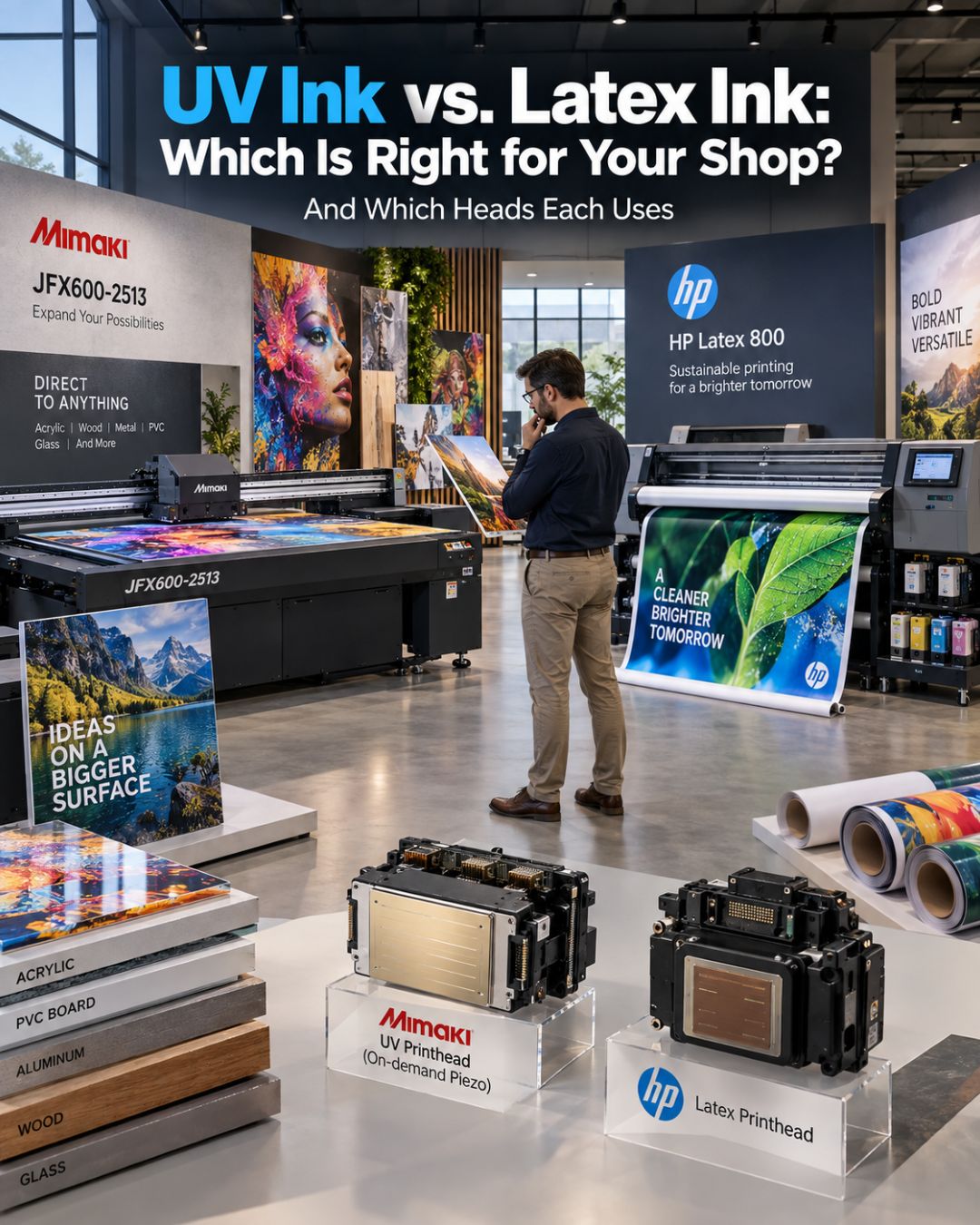
UV-curable and latex inks are the two "dry off the printer" technologies in wide format. Shops moving off eco-solvent usually pick between them, and the comparison tends to focus on substrates and finish. Add the printhead to that comparison and the picture changes: UV runs on industrial piezo heads that are a serious capital item; latex runs on thermal heads sold as consumables.
How the ink cures
UV ink is a liquid of monomers, oligomers and photoinitiators. Nothing evaporates. An LED or mercury lamp beside the carriage triggers polymerisation within a second and the ink becomes a solid film bonded to whatever it landed on — acrylic, aluminium composite, glass, wood, PVC, film. Latex ink is water-based with a latex polymer. The printer's drying and curing zones drive off water and fuse the polymer to the media with high heat. That heat limits latex to media that can take it, which mostly means flexible rolls.
Printheads: this is the real divide
| UV | Latex | |
|---|---|---|
| Head families | Ricoh GEN5/GEN6, Konica KM1024i, Kyocera KJ4A, Xaar 1003, Epson i3200-U1 | HP thermal, user-replaceable |
| Price per head | $989 (i3200-U1) to $3,000 (KM1024i) | Low hundreds |
| Heads per printer | 4–16+ on industrial flatbeds | 4–8 |
| Service life | Years; UV ink is stable in the head | Months by design |
| Worst failure | Ink cured inside the head from stray UV — not recoverable | Burn-out; swap and continue |
A UV flatbed with eight Ricoh GEN5 heads has roughly $20,000 of printheads in the carriage. That's the number a shop needs to understand before buying, and it's why UV shops have technicians and latex shops often don't.
Where UV wins
- Rigid and direct-to-object work. Signage on board, packaging prototypes, promotional items — see the Ricoh TH5241 direct-to-shape page for what industrial UV heads make possible.
- Head stability. UV ink doesn't dry in the nozzle the way aqueous or solvent inks do, so idle-time clogging is less of a problem. The hazard is the opposite: stray lamp light curing ink in the head, which is permanent.
- Cross-brand head supply. GEN5 sits in Mimaki, Roland, Mutoh and dozens of Chinese flatbeds. Konica KM1024i is similar. Supply is deep.
Where latex wins
- Textiles, wallcoverings and anything that flexes. Cured latex is soft; cured UV can crack on stretch unless it's a flexible formulation.
- No head capital risk. A dead head is a quick, cheap swap.
- Indoor certifications. Latex has the edge on low-VOC and healthcare/education environments.
The head question if you go UV
Which UV head your printer uses is fixed by the machine, but knowing the family before you buy tells you your replacement exposure. GEN5 vs GEN6 covers Ricoh; Konica replacement guide and Kyocera KJ4A-TA guide cover the other two. For entry-level UV built on Epson, the i3200-U1 at $989 is the head to know. Our best UV printheads page ranks them by application.
Frequently asked questions
Is UV or latex better for signage?
UV for rigid signage and direct-to-substrate work; latex for flexible rolls, banners, textiles and wallcoverings. For vinyl-only shops the output is comparable, so the decision usually comes down to printhead cost exposure and whether you have technical support in-house.
What printheads do UV printers use?
Industrial piezo heads: Ricoh GEN5 and GEN6, Konica Minolta KM1024i, Kyocera KJ4A, Xaar 1003, and on entry-level machines the Epson i3200-U1. Prices run from about $989 for the i3200-U1 to $3,000 for a KM1024i, and flatbeds carry four to sixteen or more.
Do UV printheads last longer than latex printheads?
Yes, by a wide margin. UV ink is stable in the nozzle and a well-maintained UV head lasts years. Latex thermal heads are consumables that wear out in months, but they cost a fraction of a UV head and take minutes to swap.
Can UV ink cure inside the printhead?
It can, and it's the one UV failure that's never recoverable. Stray lamp light, a cracked lamp shutter or leaving the carriage parked under a lamp can polymerise ink inside the head. Keep shutters and shielding intact and cap the head when idle.
Related reading
Shop: Ricoh · Konica Minolta · Kyocera · Xaar


Leave a comment
This site is protected by hCaptcha and the hCaptcha Privacy Policy and Terms of Service apply.