
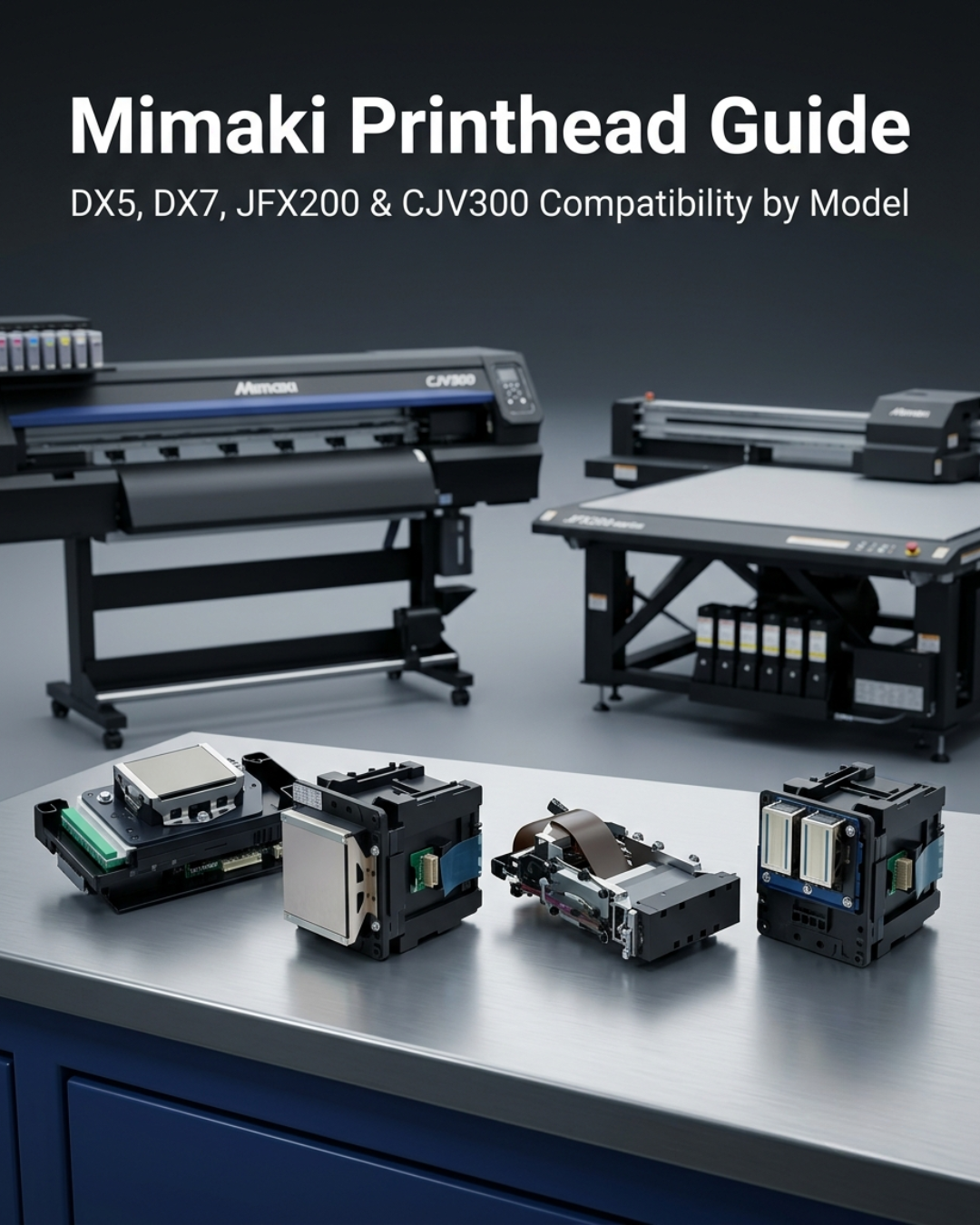
Mimaki doesn't use one printhead across its lineup — it uses at least six, spanning three technology generations. Get the wrong one and it's a final-sale mistake on a part that runs $1,500–$4,500. Here's which head goes with which machine.
Buy genuine Mimaki printheads
- Mimaki CJV300 / JV300 / CJV150 printhead M015372
- Mimaki JV34-260 printhead M010792
- Mimaki JFX200-2513 Gen5 printhead M022625
- Mimaki UCJV300 Gen5 printhead M022624
In stock · Ships same day from Doral, FL on orders before 2 PM EST · Genuine OEM, sealed
Which printhead does your Mimaki use?
| Printer Series | Printhead | Technology |
|---|---|---|
| JV33, CJV30, JV5 | Epson DX5 | Eco-solvent, piezo micro-TFP |
| JV150, JV300, CJV150, CJV300, TS34, JV34, TXF150/300 | Epson DX7 (Mimaki p/n M015372 / M015307) | Eco-solvent/mild solvent, 1,440 nozzles (8×180) |
| JFX200 | Mimaki JFX200 printhead | UV flatbed |
| UJF-3042/6042 MkII | Mimaki UJF MkII printhead | Compact UV flatbed |
| UCJV150/300 | Mimaki UCJV printhead | UV latex-solvent hybrid |
| JV400 series | Mimaki JV400 printhead | Latex / eco-solvent |
The DX5 and DX7 are Epson-manufactured heads used under a Mimaki part number — mechanically and electrically the same head found in some Roland and Mutoh machines of the same generation, which is why our DX4/DX5/DX7 Roland guide is a useful cross-reference if you're troubleshooting a shared symptom across brands.
DX5 vs DX7: what actually changed
If your JV33 or CJV30 is being retired in favor of a JV300 or CJV300, the jump from DX5 to DX7 isn't cosmetic. DX7 roughly doubles nozzle density (1,440 vs 720) and adds finer native droplet control, which is why DX7-based Mimaki output holds fine text and gradients better at the same pass count. It also means DX5 and DX7 heads are not interchangeable between machines — don't let a supplier tell you otherwise.
Signs it's the printhead, not a damper or capping station
Before ordering a replacement, rule out the two parts that fail far more often than the head itself. Our dampers, capping stations & wiper blades guide walks through the $15–$60 parts that cause most "dead printhead" symptoms. If you've already ruled those out and you're still seeing persistent banding or missing nozzles after multiple cleaning cycles, our general banding diagnosis guide and missing nozzle diagnosis guide apply directly to Mimaki DX5/DX7 machines as well.
Genuine vs. aftermarket for Mimaki heads
Because a printhead can't be returned once installed, verify the exact machine model and printhead generation before ordering — see our genuine vs. aftermarket printheads and OEM vs. generic parts breakdowns for where genuine matters most (the head itself) and where a quality generic is fine (dampers, wipers, cables).
FAQ
Can I put a DX5 head in a machine designed for DX7? No. The nozzle count, firing voltage, and carriage mounting differ. Confirm your exact model before ordering.
Do JFX200 and UJF heads use the same technology as DX5/DX7? No — these are UV flatbed printers using Mimaki's own head design, not an Epson-derived head. They're not cross-compatible with solvent/eco-solvent machines.
Where can I verify which head my specific Mimaki model uses? Check your machine's printhead compatibility on our Compatibility Database, or contact us with your model number before ordering — we verify compatibility on every Mimaki order before it ships.
Shop genuine Mimaki printheads: DX5, DX7, JFX200 & CJV300 — In Stock
Browse all Mimaki heads and parts
- Mimaki printheads
- All Mimaki parts
- Capping stations
- Dampers — all brands
In stock · Ships same day from Doral, FL on orders before 2 PM EST · Genuine OEM, sealed


Leave a comment
This site is protected by hCaptcha and the hCaptcha Privacy Policy and Terms of Service apply.