
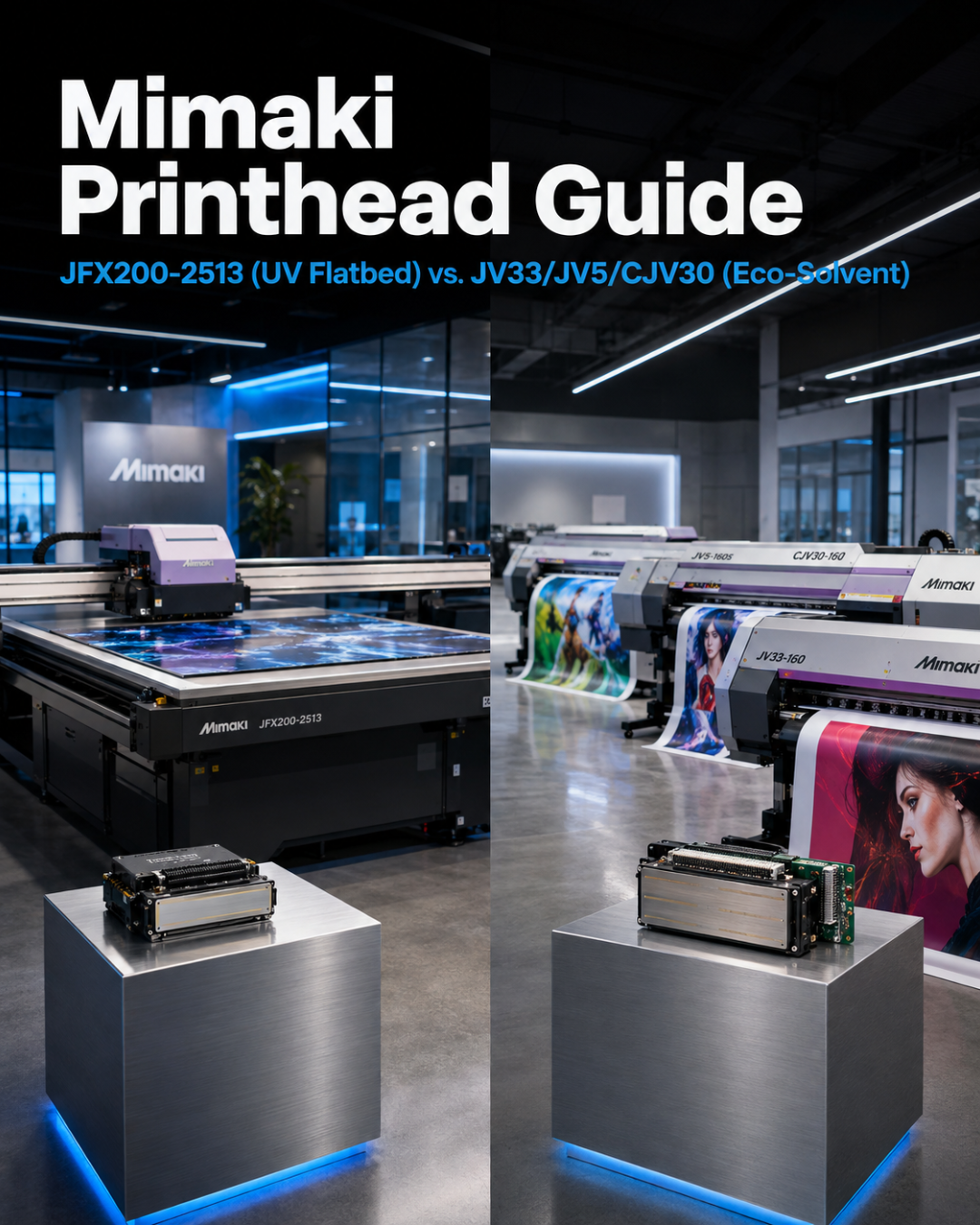
"I have a Mimaki, what printhead do I need" is one of the least answerable questions we get — not because it's a bad question, but because Mimaki's product line spans two completely different printer categories that don't share printhead architecture at all. Here's the split.
JFX200-2513: UV flatbed, Ricoh-based
If your machine is a JFX200-2513 flatbed UV printer, its printhead is a GEN5 unit built around a Ricoh MH5420 UV head — model M022625, priced around $2,750. This matters because it means everything true of Ricoh's GEN5 UV printhead family generally applies here too: this is not a Mimaki-designed print engine, it's a Ricoh engine integrated into Mimaki's flatbed platform. We cover the broader GEN4/GEN5/GEN6 Ricoh lineup and lifespan differences in our Ricoh Gen5 vs Gen6 guide — the same generational logic applies to the JFX200's print engine.
Flatbed UV printers like the JFX200-2513 typically see heavier per-head duty cycles than roll-to-roll machines because they're often running rigid substrates at higher ink laydown for opacity and texture effects, so nozzle-level maintenance discipline matters more here than on a lighter-use roll printer.
JV33 / JV5 / CJV30: eco-solvent roll-to-roll
If your machine is a JV33, JV5, or CJV30, you're in a completely different world: eco-solvent roll-to-roll printing, and the head is a Mimaki print head assembly (M007947), priced around $1,817. Unlike the flatbed's Ricoh-based engine, this print head family is specific to Mimaki's own eco-solvent architecture and isn't shared with another manufacturer's print engine the way the JFX200's is.
These three printer models (JV33, JV5, CJV30) are closely related in Mimaki's product history and commonly share the same head assembly — but always confirm against your specific machine's parts documentation before ordering, since minor internal revisions exist even within a shared part number lineage.
Why this split trips people up
Both machines say "Mimaki" on the case. Neither printer type tells you anything about the other's printhead requirements. A JFX200 owner searching generic "Mimaki printhead" terms is as likely to land on JV33-series parts as on the correct GEN5/MH5420 unit, and vice versa — they are not interchangeable in either direction.
Confirming what you have
Check your machine's model plate (usually on the rear panel or near the control interface) for the exact model — "JFX200-2513" vs. "JV33-160" vs. "CJV30-60," for example — rather than assuming from "it's a flatbed" or "it's roll-fed." If you're still unsure how to pin down the exact printhead your machine uses, our general printhead identification guide walks through where to look.
Related reading
- Ricoh Gen5 vs Gen6 Printhead: Lifetime Hours & GH2220 Compared
- Genuine vs. aftermarket printheads: what you actually risk
- Dampers, capping stations, and wiper blades
Shop: Mimaki Printheads



Leave a comment
This site is protected by hCaptcha and the hCaptcha Privacy Policy and Terms of Service apply.