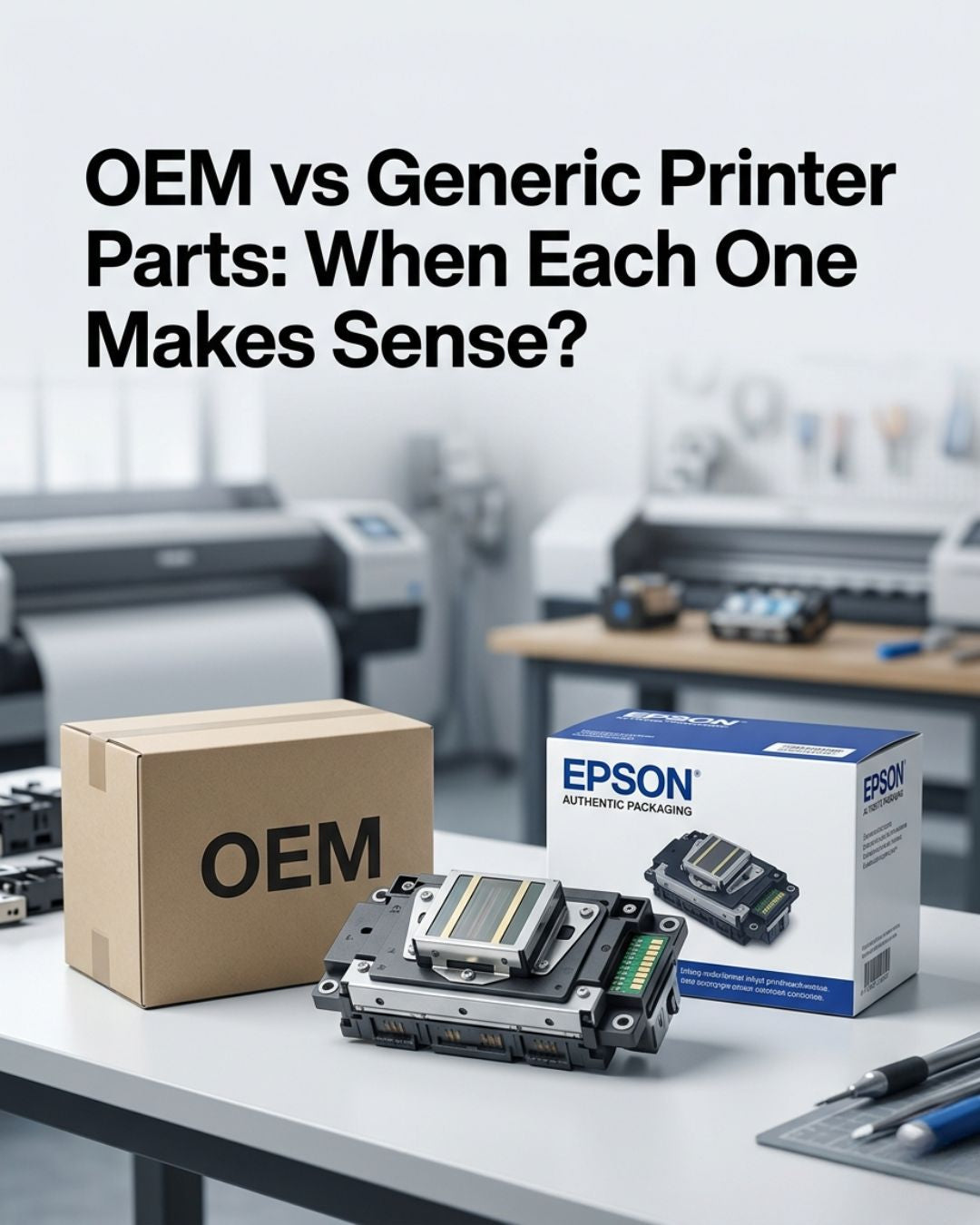
The OEM vs generic question doesn't have one answer. It depends on which part you're buying. For some parts, a generic alternative is genuinely fine and saves you real money. For others, generic doesn't really exist as a category, and what's being sold as "compatible" is something else entirely. Here's how to think through it for each part type we stock.
Printheads: there is no real "generic"
This one surprises people. Printheads are not made by aftermarket factories. The technology, tooling, and patents sit with a small number of manufacturers: Epson, Ricoh, Konica Minolta, Xaar, Kyocera, Fujifilm Dimatix. Nobody else has the equipment to fabricate a printhead from scratch.
So when you see a "compatible" or "generic" or "OEM equivalent" printhead listed cheap, you're not looking at an aftermarket-manufactured product. You're looking at one of two things:
Refurbished and resold as new. A printer reaches end of life or gets scrapped after a different failure. The printhead is removed, run through an ultrasonic cleaner, and resold. The seller might genuinely not know how many hours the head has on it. The head might work for a while or fail in weeks — there's no way to tell from the outside.
Mislabeled variants. A head that's physically similar but rated for a different ink type. A water-based DX5 sold as a solvent DX5, for example. They look identical from the outside but fail when you run the wrong ink through them.
That's the entire grey market for printheads. There is no third category of "factory-made aftermarket head" because those factories don't exist.
When we list a head as genuine original, we mean it came from the manufacturer's official supply chain through authorized distributors — not pulled from scrap — and it's a new part with zero print hours. Every printhead we sell including the Epson i3200-A1 and the XP600 (F1080-A1) ships with the manufacturer's original seal and serial number documentation.
A note on returns. We don't accept returns on printheads — and this is industry standard, not a Digiprint quirk. A printhead is one of the most sensitive components in your printer. A single wrong connection during installation can short the head. A defective carriage board upstream can short the head. By the time the head is back on our bench, there's no way to tell whether the failure was a manufacturing defect or something that happened during installation. That's why every reputable printhead supplier in the world sells them as final sale.
What this means for you: confirm compatibility before you order, and have a qualified tech do the installation. Send us your printer make, model, and ink type before checkout and we'll confirm the head fits. We'd rather lose a sale than ship you the wrong part.
Dampers, capping stations, and wipers: generic is a real choice here
This is where the OEM vs generic question is actually live. Aftermarket factories do make dampers, capping stations, wipers, and cleaning kits. They've been making them for decades. Some are excellent, some are junk. The difference is which part you're buying and who you're buying from.
Dampers — generic is usually fine if you're buying from a reputable supplier and replacing them on schedule (every 4 to 6 months in daily DTF production). The failure mode of a worn damper is gradual, so even a slightly lower-quality generic gives you warning before it affects the head. Genuine dampers tend to last a few months longer in equivalent service, but not enough to justify 3x the price for most shops. The bigger risk with dampers isn't OEM vs generic — it's not replacing them at all. For everything that can go wrong when dampers are neglected, see our guide on dampers, capping stations, and wiper blades.
Capping stations — generic varies widely. This is the part with the most quality variation in the aftermarket. A bad capping station kills printheads fast. If you're buying generic, buy from a supplier that specifies the rubber compound and seal tolerances, not the cheapest listing on a marketplace. Genuine is the safer choice if you can't verify the generic supplier's spec. A capping station that fails to seal properly will destroy a $997 head in weeks — saving $30 on a cap is rarely worth the exposure.
Wiper blades — generic is usually fine. Wipers are simpler parts. The rubber compound matters but the geometry is forgiving. Generic wipers from established suppliers perform comparably to OEM in most setups. The key is replacing them on the right schedule, not just buying OEM and assuming that covers you.
Cables and electronics: it depends what's failing
Cables fall into two camps. Power cables and basic data cables can run generic without issue. Carriage cables that carry signal between the main board and the printhead are more sensitive — a poorly shielded generic carriage cable can introduce noise that causes intermittent nozzle dropouts. These look identical to print quality issues and are difficult to diagnose. For carriage data cables, paying for genuine is worth it.
For decoder cards, Hoson adapter boards, and i3200 driver boards, stick with parts that are spec-matched to your printer. These aren't really "OEM vs generic" decisions because the boards themselves are made by a small set of specialty suppliers — some authorized, some not. What matters is that the board version matches your printer's firmware. The wrong revision of an i3200 board can cause the exact kind of carriage-board short that destroys a printhead.
Inks: don't cut corners on the printer that pays your rent
We stock DTF supplies but the ink question comes up constantly and it's worth addressing directly. Generic ink is one of the leading causes of premature printhead failure in DTF and eco-solvent shops. The chemistry has to match what the head was designed for, and "compatible with Epson DX5" on a label doesn't mean anything specific. If a head dies from running the wrong ink formulation, you're paying for a new head — and you can't point to the ink supplier as the cause, because you made the choice.
Run the ink your printhead manufacturer specifies. The savings on cheap ink almost never beat the cost of one extra head replacement. And if you're uncertain whether your current ink is damaging your head, read our guide on how to clean an Epson i3200 printhead — the ink compatibility section explains what viscosity specs actually mean for your setup.
Quick reference
Always buy genuine OEM: printheads, white DTF ink, carriage data cables, decoder boards and adapter boards.
Generic is usually fine: dampers (from reputable suppliers), wiper blades, power cables, basic data cables, cleaning solution.
Generic is a coin flip: capping stations. Buy from a supplier you can verify. If you can't verify them, buy genuine.
What Digiprint stocks
Genuine printheads only — no refurbished, no grey market. For everything else (dampers, capping stations, wipers, cables, cleaning supplies), we stock both genuine and reputable aftermarket where it makes sense, and we identify which is which on every product page. If you want a specific recommendation for your printer, send us the make and model before you order.
Browse our full range of spare parts and DTF supplies, all shipping same day from Doral, Miami. If you're also working through the cost question — how much a full printhead replacement actually runs including peripherals — see our printhead replacement cost guide for the real numbers.


Leave a comment
This site is protected by hCaptcha and the hCaptcha Privacy Policy and Terms of Service apply.