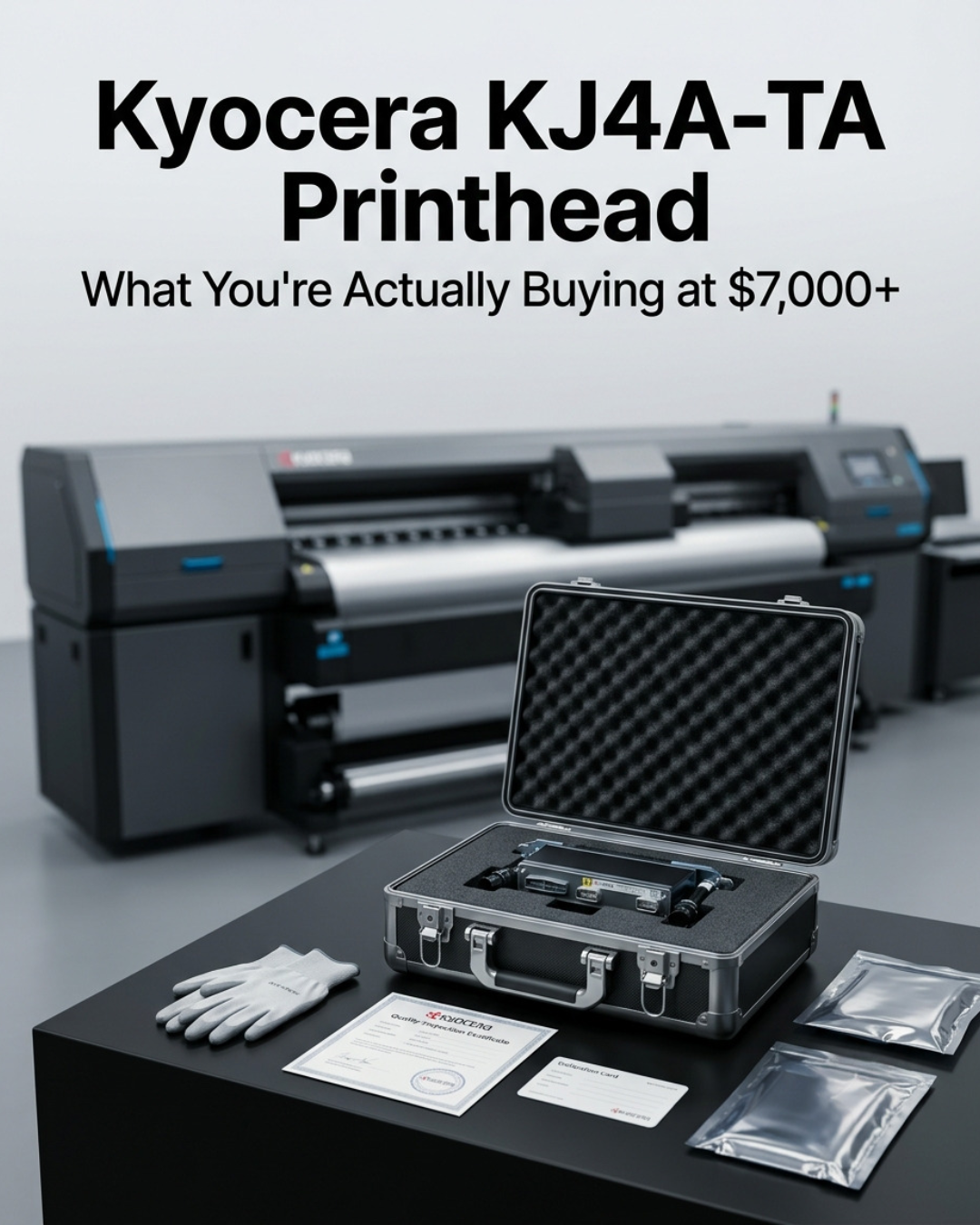
A Kyocera KJ4A-TA printhead costs more than most eco-solvent printers cost to buy new. That number stops people — until they understand what single-pass industrial print engineering actually requires.
What the KJ4A-TA is built for
The KJ4A-TA is a 2,656-nozzle, 600dpi single-pass UV printhead. That's not a typo, and it's not a wide-format eco-solvent head with a bigger price tag — it's a different category of engineering entirely. Single-pass means the substrate moves under a fixed print bar once, at production-line speed, and the full image has to form in that one pass. There's no scanning carriage going back and forth to hide a weak nozzle or a slightly-off droplet. Every one of those 2,656 nozzles has to fire correctly, every time, at speed.
That's why this head shows up in packaging lines, label converting, and industrial single-pass UV systems — not in sign shops. If your printer has a moving carriage that passes over the media multiple times, you don't have a KJ4A-TA-based machine, and this isn't your printhead.
Why the price is what it is
Three things drive the cost, and none of them are markup:
- Nozzle density. 2,656 nozzles in a single head is roughly 5-8x what a typical wide-format eco-solvent head carries. More nozzles means more silicon, more precision manufacturing, and a much lower tolerance for defects — a single dead nozzle at this density is far more visible in a single-pass image than in a multi-pass scanning system, where overlapping passes can mask it.
- Single-pass tolerance. Because there's no second pass to correct for a weak jet, Kyocera's manufacturing tolerances for this head are tighter than for a scanning-head design.
- Low volume, high spec. Single-pass industrial UV printers are a smaller market than wide-format sign printers, so these heads don't benefit from the same manufacturing scale as, say, an Epson i3200.
Genuine vs. aftermarket — there isn't really a choice here
For consumer-tier printheads like the Epson i3200, we've written about when genuine vs. aftermarket is a real decision with tradeoffs. At the KJ4A-TA's tier, that decision doesn't really exist — the aftermarket compatible market for single-pass industrial heads at this nozzle density is thin to nonexistent, and the failure cost of a bad clone in a production line (stopped output, damaged carriage, voided printer warranty) dwarfs any savings. Every KJ4A-TA we sell is genuine Kyocera.
Before you order
Confirm your printer's exact model and print bar configuration before ordering — Kyocera's KJ4 family has multiple variants (KJ4B, KJ4A-QA, KJ4A-TA) that are not interchangeable despite looking nearly identical. If you're not sure which variant your machine uses, check your printer's service documentation or reach out with your printer model and we'll confirm before you order — a $7,200 mistake isn't one you want to make twice. If you're unsure how to identify what's actually installed in your machine, see our printhead identification guide.
Related reading
- Genuine vs. aftermarket printheads: what you actually risk
- How much does it cost to replace a printhead?
- Dampers, capping stations, and wiper blades
Shop: Kyocera Printheads



Leave a comment
This site is protected by hCaptcha and the hCaptcha Privacy Policy and Terms of Service apply.