
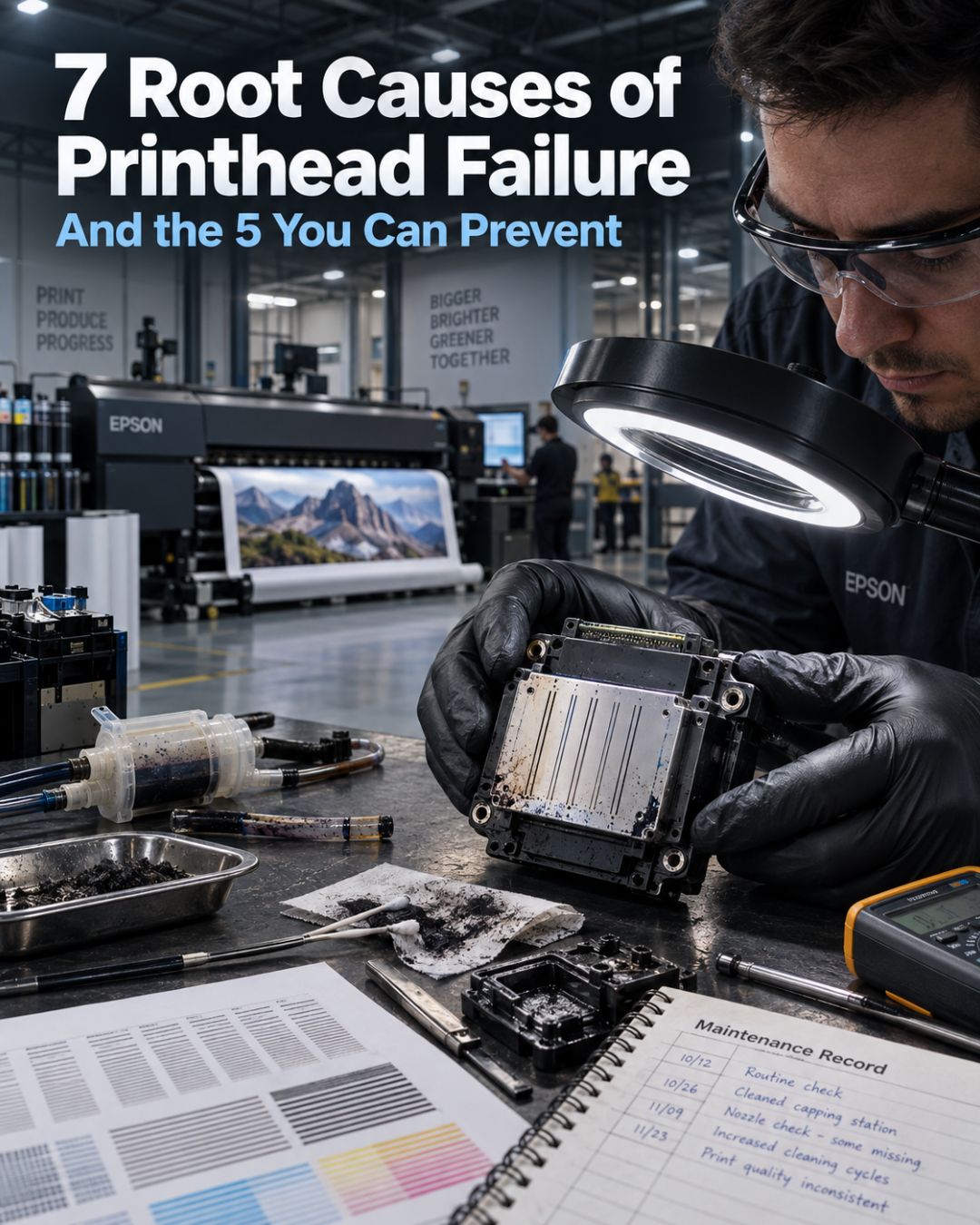
When a head comes back to us as "failed," the story behind it is usually one of seven things. Two are bad luck. Five are the shop's maintenance routine, or the lack of one. Here they are in the order we see them, with what actually prevents each.
1. Dried ink from poor capping (preventable)
The capping station is the seal that keeps the nozzle plate wet between jobs. A cap with a cracked lip, a hardened rubber seal, or a clogged suction line lets air in, and the ink at the nozzle face dries. Every overnight becomes a mini-clog. A capping station costs $28–$60 and should be replaced on a schedule, not when it visibly fails. If you see ink pooling on top of the cap instead of being drawn through it, it's already past due.
2. Worn wiper blades scratching the plate (preventable)
A wiper's job is to clear ink off the nozzle plate with a soft edge. Once the edge hardens, chips, or picks up dried pigment, it drags across the plate and scores the coating. Deflected drops and "phantom" banding follow. Wipers are the cheapest part in the maintenance chain; change them every time you change the cap.
3. Air or ink starvation from failed dampers (preventable)
A damper is a small reservoir with a filter membrane that smooths ink delivery to the head. When the membrane fails or air gets in, the head fires with inconsistent pressure — partial nozzle drop-out that comes and goes. Left long enough, the head runs dry and the piezo elements fire against nothing. i3200 dampers are $6.50 each; our ink starvation guide shows the symptom pattern.
4. White ink settling in DTF systems (preventable)
DTF white uses titanium dioxide pigment that sinks in the tank and the lines. If the printer sits without agitation or recirculation, sediment migrates into the head chamber. This is the single biggest killer of i3200 and XP600 heads in DTF shops. Daily agitation, a working recirculation loop, and a white-ink flush before any idle period over 48 hours prevent it. Our DTF maintenance schedule lays out the cadence.
5. Electrical damage during installation (preventable)
A head board can be destroyed — along with the head — by connecting the data cable with the printer powered on, or by seating it one pin off. Pins on the 14-pin i3200 cable and the 29-pin XP600 cable are small and easy to misalign. Power off at the switch, confirm orientation against the old cable, and replace cables that show any kinks or exposed conductor. We recommend a fresh cable with every head; at $7.50 it isn't worth reusing.
6. Head strikes (partly preventable)
Media lifting into the carriage path scratches the plate or cracks the head housing. Curling film, warped boards on a flatbed, and wrong head-height settings are the usual triggers. See our guide on head strikes on wide-format printers.
7. Ink chemistry mismatch (not preventable after the fact)
Running solvent ink through an aqueous head, or switching ink brands without a full flush, attacks internal coatings and seals. The damage is progressive and irreversible. Match the head variant to the ink — the i3200 A1/E1/U1 suffix exists for exactly this reason.
The parts that prevent five of seven failures
Cap, wipers, dampers, cable, and a matched cleaning solution. That's it. A complete kit for an i3200 DTF printer is a fraction of the head it protects, and our comparison of kits vs. buying parts separately covers when each makes sense.
Frequently asked questions
What is the most common cause of printhead failure?
Dried ink caused by a worn or leaking capping station. The cap is what keeps nozzles wet between jobs; once it stops sealing, every idle period dries the nozzle face a little more until cleaning cycles can't clear it.
Can a printhead be damaged during installation?
Yes, and it's common. Connecting the head data cable with the printer powered on, or seating it one pin off, can destroy the head and the head board at the same time. Always power off, match the cable orientation to the old one, and use a new cable.
Why do DTF printheads fail faster than eco-solvent heads?
White DTF ink carries heavy titanium dioxide pigment that settles when the printer sits. Without daily agitation and a working recirculation loop, that sediment reaches the head chamber and clogs it. Eco-solvent inks don't have this settling problem.
How often should I replace capping stations and wipers?
On a schedule tied to your print volume, not when they visibly fail. For a DTF or eco-solvent printer in daily production, inspect monthly and replace every 3–6 months; replace both together since the wiper wears at a similar rate to the cap seal.
Related reading
- Dampers, capping stations and wiper blades
- Why your wide-format printer keeps clogging
- Printhead Troubleshooting Center
Shop: Maintenance Kits · Dampers · Capping Stations · Wipers



Leave a comment
This site is protected by hCaptcha and the hCaptcha Privacy Policy and Terms of Service apply.