
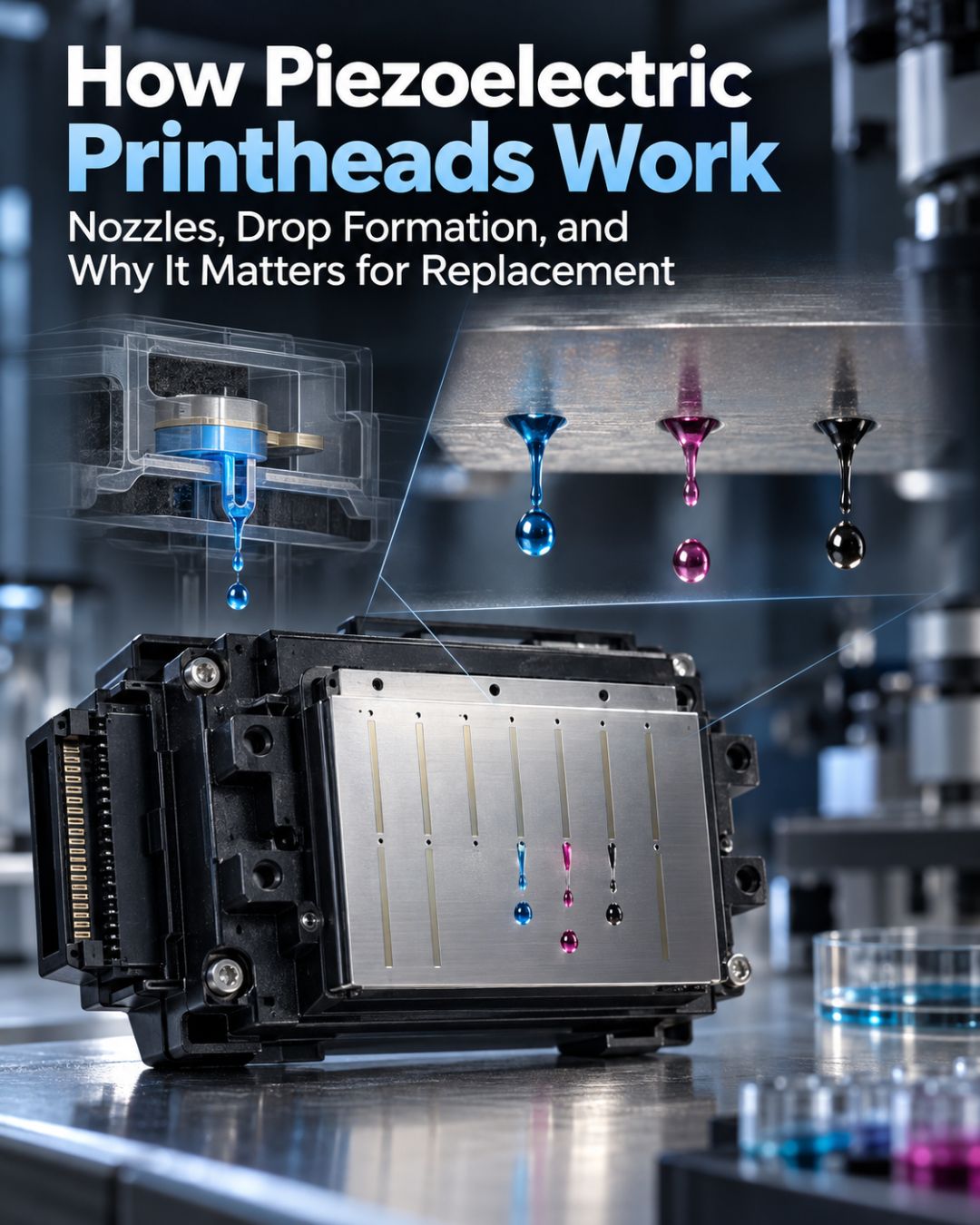
A piezoelectric printhead is an inkjet head that fires ink by physically flexing a ceramic crystal behind each nozzle. No heat, no boiling, no bubble. Apply voltage, the crystal deforms, the chamber squeezes, a drop leaves the nozzle. Every wide-format head in our catalog — Epson, Ricoh, Konica Minolta, Kyocera, Xaar — works this way, and the design decides how they fail, what they cost, and whether they can be recovered.
What happens inside the nozzle
Each nozzle sits at the end of a tiny ink chamber. One wall of that chamber is a piezo element (usually lead zirconate titanate, PZT). The printer's head board sends a shaped voltage pulse; the element flexes inward, pressure spikes, and a drop of a few picolitres pushes out. Reverse the voltage and the chamber refills from the manifold. This is drop-on-demand: nothing fires unless the board tells it to, which is why a bad data cable or head board can look like a dead head.
Scale that up and you get the nozzle counts on our spec sheets: 3,200 nozzles on the Epson i3200-A1 (8 rows × 400), 2,656 on the Kyocera KJ4A-TA, 1,280 on the Ricoh GEN5 MH5440. Each one is its own chamber and its own piezo element.
Piezo vs. thermal: why wide-format went piezo
Thermal inkjet (most desktop HP and Canon heads) boils a micro-bubble of ink to eject the drop. It's cheap to make, which is why those heads are treated as consumables. But heat limits which inks you can run — solvent, UV, and heavy pigment loads don't tolerate it. Piezo heads don't care what's in the chamber as long as viscosity is in range, so one head architecture can run eco-solvent, UV, aqueous, or DTF ink with a different plate coating and channel setup. That's the whole reason the i3200 family exists as A1, E1, and U1 variants — see our i3200 suffix guide.
What the design means when something goes wrong
- Clogs are mechanical, not electrical. Dried ink in the chamber stops the drop, but the piezo element is usually fine. That's why reading a nozzle check matters — a gap that moves after a clean is a clog; a gap that never moves is something else.
- Electrical damage is permanent. A voltage spike from hot-plugging a cable can kill a row of piezo elements. No flush brings that back.
- The nozzle plate is the fragile part. Head strikes and aggressive wiping scratch the plate and the coating that keeps ink beading correctly. Once the coating is gone, deflection and satellite drops follow.
- Everything upstream affects drop formation. Air in a damper or a worn capping station changes chamber pressure, so the head misfires even though nothing inside it is broken.
Why this changes how you buy
Because piezo elements are manufactured to tight tolerances and matched in rows, a head is sold as a sealed, calibrated unit. There is no field-serviceable part inside it. Protecting the $389–$3,000 investment comes down to the $6–$60 parts around it, which is the argument we make in dampers, capping stations and wiper blades. And it's why we only stock genuine heads: a piezo element's firing curve is what the printer's waveform is tuned for, and an aftermarket clone with a different element is an unknown quantity. More on that in genuine vs. aftermarket printheads.
Frequently asked questions
Are all wide-format printheads piezoelectric?
Nearly all professional wide-format heads are — Epson, Ricoh, Konica Minolta, Kyocera, Xaar, Fujifilm Dimatix and Seiko all use piezo. The main exception is HP's Latex line, which uses thermal heads sold as user-replaceable consumables. If your printer runs solvent, UV, or DTF ink, it's piezo.
Does a piezo printhead wear out?
Yes, but slowly. The piezo elements themselves last a very long time; what ends a head's life is usually nozzle-plate damage, dried ink that can't be cleared, or electrical damage from a cable or board fault. Good capping and wiping extends life far more than anything you can do to the head itself.
Can a piezo printhead run a different ink than it was built for?
Not safely. Chamber coatings, nozzle-plate treatment and internal seals are matched to an ink family. An i3200-A1 (aqueous/DTF) will not survive long on eco-solvent, and a solvent head will misfire on water-based ink. Always match the variant suffix to your ink.
Why does a new printhead sometimes print worse than the old one?
Because the old head was compensated for in the printer's alignment and waveform settings. A new head needs head alignment, bi-directional calibration and, on some boards, a head rank or ID entered. If you skipped those, the head isn't faulty — the printer is still tuned for the old one.
Related reading
Shop: All Printheads


Leave a comment
This site is protected by hCaptcha and the hCaptcha Privacy Policy and Terms of Service apply.