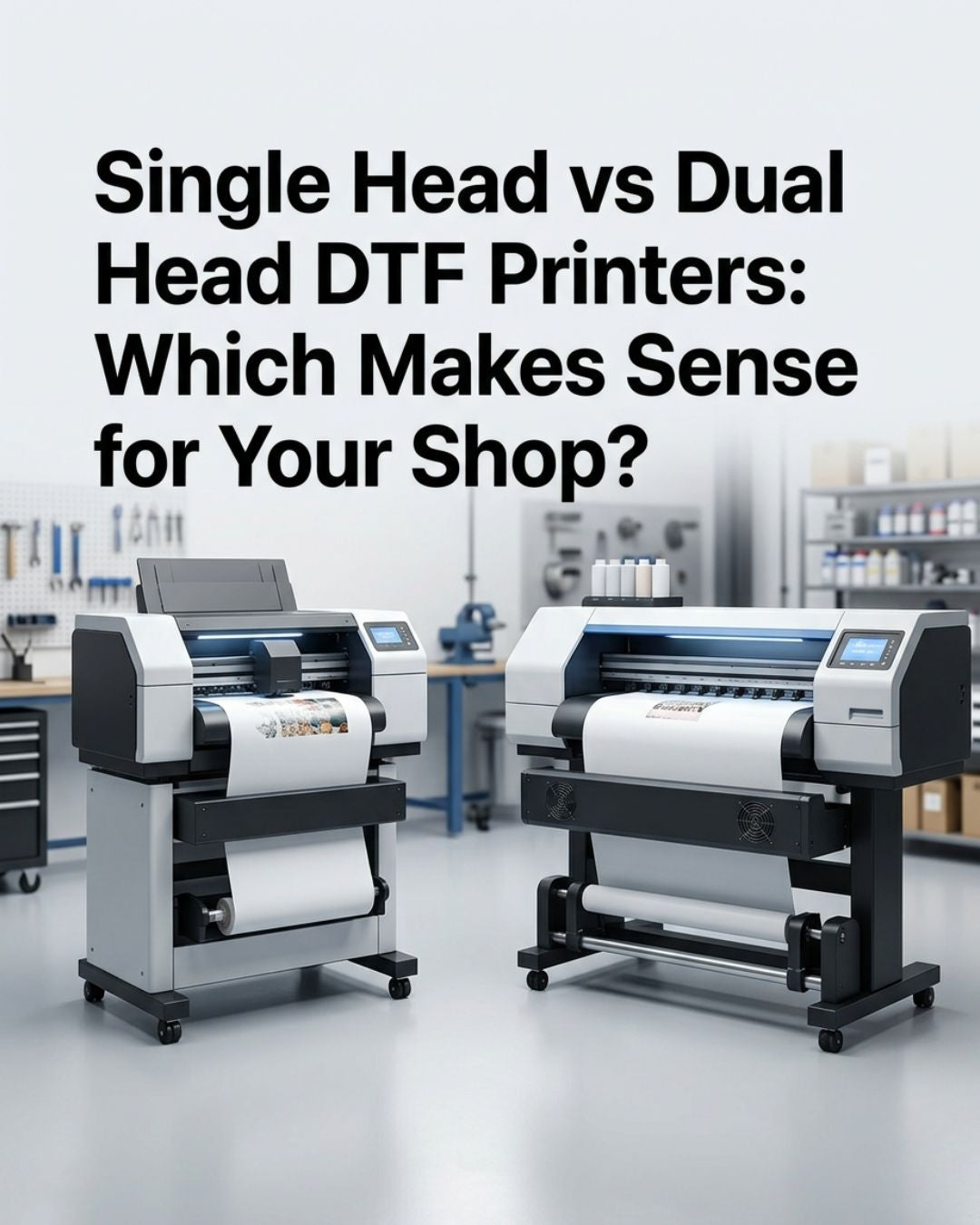
Dual head DTF printers run roughly 80% to 100% faster than single head printers in real production — not the 200% you sometimes see advertised. They also double the cost of every printhead replacement and most parts failures. Whether that math works depends on how many transfers you're actually pressing per day.
This post is for shops choosing their first DTF machine, or shops adding capacity and trying to decide whether to upgrade.
How the speed difference actually works
A single head DTF printer — one Epson XP600 or i3200-A1 — prints in one pass. The head moves back and forth across the film, laying down the white ink base layer and color layer in sequence. Speed is limited by how fast the head fires and how fast the carriage travels.
A dual head printer has two heads side by side. Each covers half the print width. The carriage still moves the same speed, but each pass lays down twice the ink in the same time. In a well-configured dual head setup, white ink and color happen in roughly half the time of a single head pass.
Theoretical speed gain: 2x. Real-world speed gain: 1.5x to 1.8x. The gap comes from setup time, RIP processing, film handling, and powder station unloading — none of which speed up because of a second head.
For a 24-inch DTF printer running standard t-shirt transfers, the practical numbers:
| Configuration | Real-world output |
|---|---|
| Single Epson i3200-A1 | 6 to 9 sq meters/hour |
| Dual Epson i3200-A1 | 11 to 16 sq meters/hour |
| Single Epson XP600 | 4 to 6 sq meters/hour |
| Dual Epson XP600 | 7 to 10 sq meters/hour |
These are production shop figures, not manufacturer specs. Your numbers will vary based on RIP settings, ink coverage percentage, and film width.
What dual head costs you
Higher upfront hardware cost. Expect roughly 1.6x to 2x the price of a comparable single head printer. The second head, the wider carriage, and the more complex electronics all add to the base price.
Printhead replacements double. When one head goes, most shops replace both at the same time so they wear evenly and maintain calibration. A single genuine XP600 replacement is $398. Two is $796. A single genuine i3200-A1 is $997. Two is $1,994. This isn't a one-time event — it happens every 12 to 24 months in normal DTF production.
Damper sets and capping stations double. When you install new heads, you install new dampers and fresh capping stations at the same time — which is how you protect the new heads. You should never install fresh heads onto worn peripherals. On a dual head machine, that means two damper sets and sometimes two capping stations per service event. Cleaning solution consumption runs about 1.5x on dual head setups because both heads share the same cleaning station on most designs. The full picture on what these peripheral costs add up to is in our guide on dampers, capping stations, and wiper blades.
Maintenance time increases. Daily nozzle checks cover two heads instead of one. Cleaning cycles take longer. Calibration is more complex — the two heads need to be aligned to each other horizontally, not just to the media. On a dual head machine, a slight bidirectional misalignment between the two heads shows up as double-strike artifacts that don't respond to standard alignment procedures. It requires specific dual-head calibration routines.
Electronics are more complex. Dual head machines use more sophisticated carriage boards — either a 4-head Hoson board or a 2-head Hoson board depending on configuration. When a board fails, diagnosing which head or which channel is the source of the fault is harder than on a single head machine. More components means more potential failure points.
When dual head is worth it
You're running 100 or more transfers per day in consistent production. At that volume, the speed difference directly affects payroll. If the printer is the bottleneck holding back your team — if the press operator or the powder station is waiting on the printer — a dual head setup pays for itself in months on labor savings alone.
You're handling regular rush orders that need 24-hour turnaround. Dual head gives you slack capacity for emergency jobs without displacing your normal production schedule. A single head machine at full capacity has no room for surprises.
You have the cash flow to handle 2x parts costs without disruption. If a single $997 i3200-A1 replacement is a significant budget event for your shop, a dual head machine will put you in that position twice as often, for twice the amount. That math needs to work before you commit.
When single head is the right call
You're running fewer than 50 transfers per day. The speed advantage of dual head doesn't translate to your bottom line at this volume. Your production bottleneck is more likely in prepress, curing, or order intake — none of which a faster printer fixes.
You're new to DTF and still building your workflow. A single head machine teaches you everything you need to know about DTF production — white ink maintenance, nozzle check habits, capping and damper replacement cycles — at half the parts cost when something goes wrong. When something does go wrong, and it will in the first year of any new setup, you're troubleshooting one head, not two. Our guide on cleaning and maintaining the Epson i3200 covers everything a new operator needs to build those habits.
Print quality on fine detail or complex artwork is a priority. A single head machine with careful calibration sometimes produces cleaner output than a dual head with even slight misalignment between the two heads. On fine text below 8pt or photographic gradients, that alignment tolerance is visible in the final transfer.
The hybrid approach: two single head machines
Worth considering before you commit to a dual head setup. Two single head printers cost roughly the same as one dual head printer. They give you full redundancy — when one machine is down for maintenance or a head swap, the other keeps running. You can also run two different jobs simultaneously (one printer on white garments, one on dark) without changing setups or splitting a run.
The trade-offs are real: double the floor space, double the daily maintenance attention, and you can't combine the speed of both machines on a single wide job the way you can with a dual head. But for a shop where uptime matters more than peak output speed, two singles often beats one dual — especially in the first two years before you fully understand your maintenance rhythm.
What we stock for either path
For single head setups: genuine Epson XP600 (F1080-A1) at $398 — the most common DTF head in production — and genuine Epson i3200-A1 at $997 for higher-end single head machines.
For dual head setups: the same heads, plus the 4-head Hoson board and 2-head Hoson carriage board for the electronics side. We carry the boards, decoder cards, and damper sets that go with each configuration — not just the heads themselves.
All in-stock parts ship same day from Doral, Miami. If your production printer goes down mid-week, the replacement head and all the peripherals you should install with it can be at your door the next morning at standard ground rates for most of Florida and next-day rates for most of the Southeast. Browse the full DTF supplies catalog or go straight to all printheads to check current stock.
If you're also working through the total cost of a head replacement — what it actually runs including dampers, capping station, cleaning solution, and labor — see our printhead replacement cost guide for the real numbers by model before you commit to either path.


Leave a comment
This site is protected by hCaptcha and the hCaptcha Privacy Policy and Terms of Service apply.